Bachelor of Science in Elementary Education

Elementary Education

A row of multi-colored overshoes along one wall; a promising shelf of animal puzzles and Elmo books; one clean markerboard with your name in green, underlined once; a laptop computer and a neon-purple printer; a narrow closet at the back that smells of lavender and chalk. Only three teachers before you have hung their coat in that closet in the eighty years since the school opened.

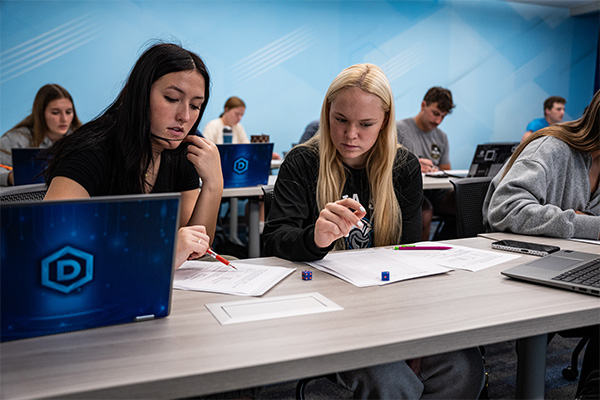
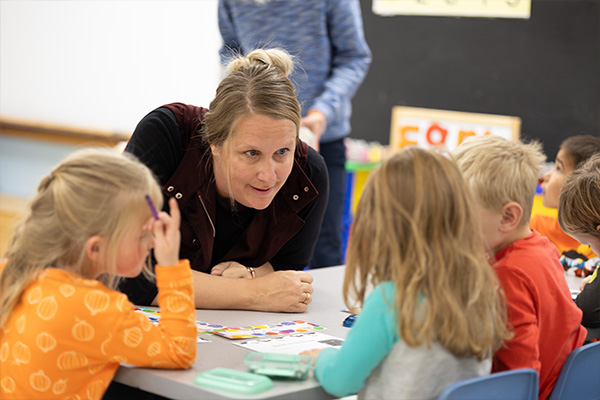
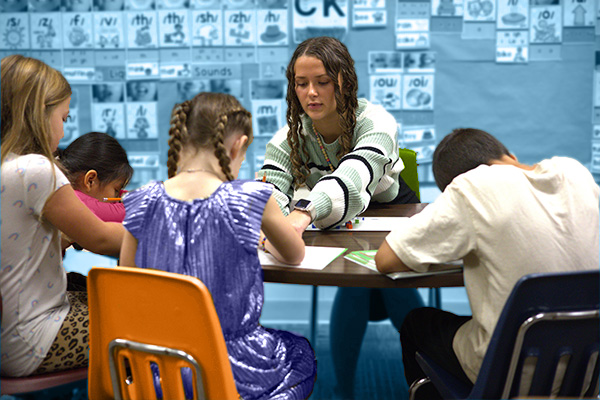
Your room almost vibrates with the promise of a new year, a new batch of playful, spirited, curious, and promising children will return from recess in nine minutes and propel you into action again: watching the Mars rover check for ice on NASA's website, fraction challenges in math, silly YouTube songs, fabric art projects, and this afternoon a local farmer you know will bring in an incubator full of eggs. The children will learn the about the life cycle of ducks, but you can't help thinking about the similarity between that warm incubator and the four walls of your classroom, the time and effort and warmth you bring each day, and the ideas and energy the children radiate. Not even your student teaching back at DSU could prepare you for the sense of ownership and of pride, and of, well, home you would know someday in a room you fill every day you teach.

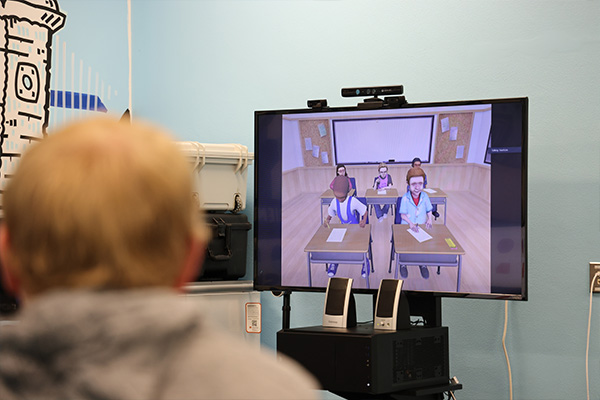
DSU's elementary education major is steeped in this sort of awareness, but happily married to the use of technology in the classroom, something every principal wants to hear in an interview. DSU knows that teaching is so much more than the paperwork, certification rules, and lesson plans. Teaching is an utterly human activity, full of emotion and driven by guts and joy. Come study with us here at DSU.

Just leave your overshoes at the door.

Salary Range:

Mid 20's to Mid 30's

Job Outlook:

Excellent

What are the benefits of a DSU Degree?

  • Integrated Technology: Extensive experience with technology in education
    • Extensive experience with technology in education
  • Special opportunities:
    • In-depth field experiences: Outstanding student teaching experiences, students receive practicum experiences prior to student teaching.
  • What type of special opportunities can students take part in? (i.e. scholarships, grants, research opportunities, internships, clubs, organizations, etc.)
    • Council of Exceptional Children (CEC) The largest organization of special education professionals, availability to travel to state & national special education events.
Nutrition Facts
Serving Size 1 Semester (16cr)
Semesters Per Degree 8 (128cr)*
Bachelor of Science in Elementary Education
Degree Requirements 128-29 cr
Credits
General Education Requirements 41-42
BIOL 101 Biology Survey I/Lab 3
Select one of the following: (Natural Sciences) 3-4
BIOL 103 Biology Survey II/Lab
CHEM 112 General Chemistry I/Lab
PHYS 111 Introduction to Physics I/Lab
CIS 130 Visual Basic Programming 3
CSC 105 Introduction to Computers 3
ENGL 101 Composition I 3
ENGL 201 Composition II 3
Select one of the following: (Arts & Humanities) 3
ENGL 210 Introduction to Literature**
ENGL 211 World Literature I*
ENGL 212 World Literature II*
ENGL 221 British Literature I
ENGL 222 British Literature II
ENGL 241 American Literature I
ENGL 242 American Literature II
ENGL 268 Literature
Select one of the following: (Arts & Humanities) 3
HIST 121 Western Civilization I*
HIST 122 Western Civilization II*
ARTH 100 Art Appreciation
ARTH 231 Survey of Art, Music, Theatre
MUS 100 Music Appreciation*
THEA 100 Intro to Theatre*
Select one of the following: (Arts & Humanities) 3
HIST 151 US History I**
HIST 152 US History II**
MATH 102 College Algebra 3
POLS 100 American Government 3
PSYC 101 General Psychology 3
SPCM 101 Fundamentals of Speech 3
WEL 100/100L Wellness for Life with Lab 2
NOTE: *Students are required to complete a course that provides a globalization/global perspectives. Courses marked with an "*" meet this requirement.
** Students are required to complete a course that provides a writing intensive experience. Courses marked with an "**" meet this requirement.
Pre-Professional Block 26
CIS 350 Computer Hardware, Data Communication & Networking 3
EDFN 338 Foundations of American Education 2
ELED/ESCI 303 Earth & Physical Science for Elementary Teachers/Lab 4
ELED 440 K-8 Language Arts Methods 2
EPSY 302 Educational Psychology 3
HLTH 251 First Aid and CPR 1
LIBM 205 Children's Literature 2
MATH 341 Mathematical Concepts for Teachers I 3
MATH 342 Mathematical Concepts for Teachers II 3
SPED 100 Intro to Persons with Exceptionalities 3
Early Professional Block 32
ARTE 310 K-8 Art Methods 2
EDFN 365 Computer-Based Technology and Learning 3
EDFN 366 Teaching using Video Conferencing 1
EDFN 475 Human Relations 3
ELED 450 K-8 Reading Methods 3
ELED 453 Diagnosis & Correction of Reading 3
EPSY 330 Human Growth & Development 3
GEOG 312 Geography for Elementary Teachers 2
HLTH 420 K-12 Methods of Health Instruction 2
INED 411 South Dakota Indian Studies 3
MLED 300 Survey of Middle Level Education 1
MUS 353 K-8 Music Methods 2
PE 360 K-8 Physical Education Methods 2
SPED 460 Family Systems and Professional Collaboration 2
Advanced Professional Block 17
ED 471 Classroom Management 2
EDER 415 Educational Assessment 2
ELED 320 K-8 Science Methods 3
ELED 330 K-8 Math Methods 3
ELED 360 K-8 Social Studies Methods 2
ELED/SPED 454 Guided Reading 3
SPED 400 Teaching in Diverse Classrooms 2
Student Teaching Semester 12
EDFN 465 Multimedia & Web Development in Education 2
ELED 488 K-8 Student Teaching 10
* The serving size is based on a four year degree plan, so your course load may vary depending on your specific educational goals. The values here are current as of the 2008-09 DSU course catalog.
 
Last Updated: 8/26/08