Bachelor of Science in Mathematics Education

School Administrators often stumble over each other in their rush to hire our Math Ed grads. It's a little embarrassing, so we look at a magazine and pretend not to notice until they've regained their composure. You might do the same. It's only polite.


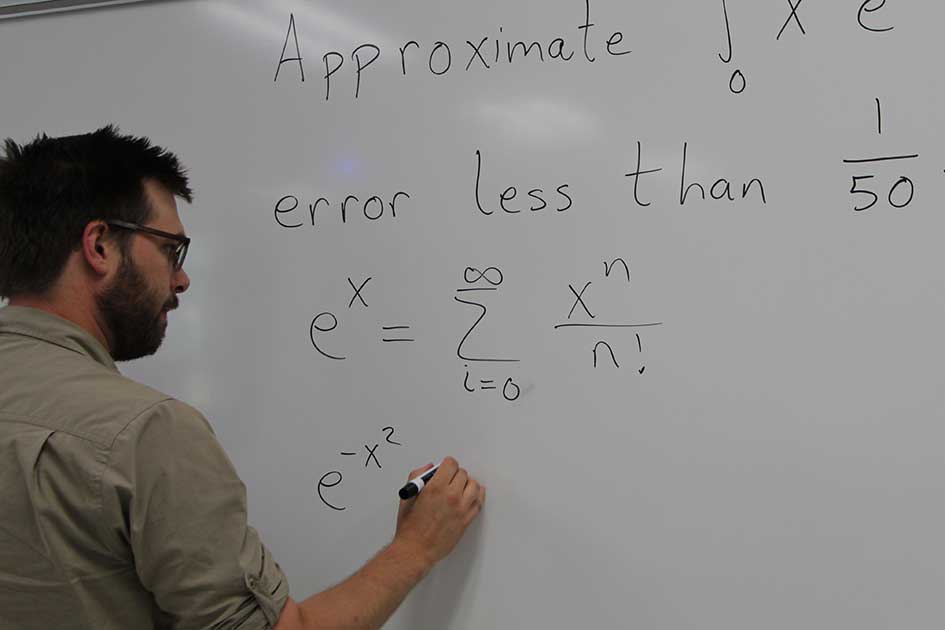
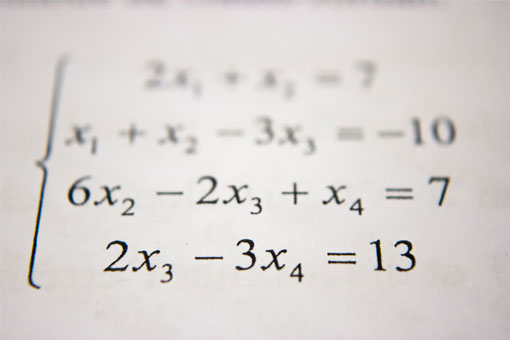
Not everyone grasps the simple beauty and elegance of a perfectly expressed equation. You do. Not everyone can encounter a complex, real life problem, and know that it can be expressed mathematically and solved in short order, perhaps on a calculator, perhaps on their Tablet PC. You do. Not everyone reels and relishes the challenge the day they learn that there are, in fact, sizes of infinity. But you will. And that's exactly why we need the greatest Math teachers.

DSU's Mathematics Education major will prepare you to teach both math and computer science classes. Not only will you have a full fledged Mathematics Education major, but we also tie this major to a minor in Computer Science. You'll even have a K-12 certified technology endorsement.

We have a lot to teach you here at DSU, but one thing you already know: When it comes to being prepared to teach, you can't be over-prepared.

Possible Job Titles:

  • High School Mathematics Teacher
  • Technology Coordinator

Salary Range:

Mid 20's to Mid 30's

Job Outlook:

Excellent

What are the benefits of a DSU Degree?

  • Class size/personal attention (Faculty-Student ratio):
    • Small class sizes that allow for extensive student-teacher interaction.
  • Integrated Technology:
    • Computer technology is integrated throughout the curriculum with students learning how to use mathematical modeling software, a computer algebra system, spreadsheets and the Geometer's Sketchpad to analyze and solve mathematical problems.
  • What type of special opportunities can students take part in?
    • There is ample opportunity for students to be trained and work as tutors in the Math Success Center which utilizes a computer assisted instruction tool to deliver remedial mathematics classes.
Nutrition Facts
Serving Size 1 Semester (16cr)
Semesters Per Degree 8 (128cr)*
Bachelor of Science in Education in Mathematics with Computer Education Minor
Degree Requirements 128 cr
Credits
Mathematics Core 34
MATH 125 Calculus II 4
MATH 201 Intro to Applied Math 3
MATH 281 Introduction to Statistics 3
MATH 315 Linear Algebra 3
MATH 316 Discrete Mathematics 3
MATH 341 Mathematical Concepts for Teachers I 3
MATH 342 Mathematical Concepts for Teachers II 3
MATH 361 Modern Geometry 3
Select 9 credits from the following: 9
MATH 225 Calculus III 4
MATH 318 Advanced Discrete Mathematics 3
MATH 321 Differential Equations 3
MATH 381 Intro to Probability & Statistics 3
MATH 413 Abstract Algebra I 3
MATH 418 Mathematical Modeling 3
MATH 471 Numerical Analysis I 3
MATH 475 Operations Research 3
MATH 492 Topics 1-6**
MATH 498 Undergraduate Research/Scholarship 2
** May be repeated several times provided student does not enroll in the
same topics course.
Computer Education Component 15
CIS 350 Computer Hardware, Data Communications & Networking 3
CSC 150 Computer Science I 3
Choose three credits from the following
3
CSC 206 Adv. Applications 1
CSC 207 Adv. Applications: Spreadsheet 1
CSC 208 Adv. Applications: Database 1
CSC 209 Adv. Applications: SAS 1
EDFN 365 Computer-based Technology and Learning 3
EDFN 366 Teaching Using Video Conferencing 1
EDFN 465 Multimedia Web Dev. in Education 2
Professional Education Core 33
NOTE: Students planning to teach outside South Dakota are encouraged to take SPED 100 for 3 credits and HLTH 201 ATOD Prevention Education for 2 credits.
Pre-Professional Block
EDFN 338 Foundations of American Education 2
EPSY 302 Educational Psychology 3
INED 411 South Dakota Indian Studies 3
SPED 100 Intro to Persons with Exceptionalities 2
Early Professional Block
EDFN 475 Human Relations 3
EPSY 330 Human Growth & Development 3
SEED 450 7-12 Teaching Reading in the Content Area 3
Advanced Professional Block
SEED 302 Secondary and Middle Level Content Methods: Math Major 2
SEED 303 Secondary and Middle Level Content Methods: Science Minor 1
Student Teaching Semester
SEED 401 Methods of Education Technology 1
SEED 471 Secondary Education Classroom Management (RECOMMENDED) 1
SEED 488 7-12 Student Teaching 10
Electives 5
NOTE: One of these credits are met when completing MATH 123 as part of the system general education.
General Education Requirement 30
Institutional Requirement 11
NOTE: Majors must take PSYC 101, MATH 123 and HIST 151 or HIST 152 as part of the system-wide general education requirement.
Majors must take CIS 130 as part of the institutional graduation requirement.
* The serving size is based on a four year degree plan, so your course load may vary depending on your specific educational goals. The values here are current as of the 2009-10 DSU course catalog.
 
Last Updated: 8/4/09