
Bachelor of Science in Mathematics for Information Systems
Graduates of the Mathematics for Information Systems program will have backgrounds in mathematics, business and information systems. These students take a variety of mathematical analysis courses including calculus, probability and statistics, and mathematical modeling. In addition, these students take a variety of computer and business related courses including computer programming, operating systems, data base applications, and business.


Possible Job Titles:
- Business Statistician
- Data Reduction Technician
- Statistical Assistant
- Computer programmer
- Computer systems analyst
- Software developer
- Business consulting
- Accountant, data processor
- Operations research
- Statistician
- Actuary
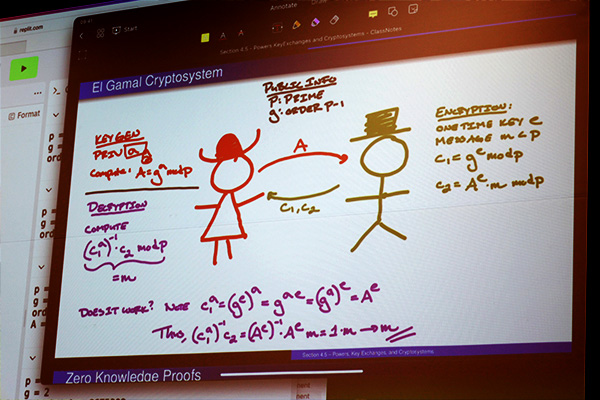
- Cryptologist
Salary Range
Mid 30's to Mid 40's
Job Outlook:
Excellent (our Math majors are among the most in-demand graduates on this campus)
What are the benefits of a DSU Degree?
- Class size/personal attention (Faculty-Student ratio):
- Small class size and excellent faculty-student ratio
- Cool facts or interesting things about this major:
- Our Mathematics for Information Systems major is relatively unique in that students majoring in Computer Science or any of the Natural Sciences (Biology, Chemistry, or Physical Science) can double major in Mathematics by just completing the mathematics courses in the math major.
- Faculty's unique experiences or certifications in this major:
- Faculty possess expertise in mathematical modeling, difference equations, and discrete mathematics
- Integrated Technology:
- Students have an opportunity to participate in DSU's tablet initiative.
| Nutrition Facts | |
|---|---|
| Serving Size 1 Semester (16cr) Semesters Per Degree 8 (128cr)* |
|
| Bachelor of Science in Mathematics for Information Systems | |
| Degree Requirements | 128 cr |
| Credits | |
| Mathematics Core | 28 |
| MATH 125 Calculus II | 4 |
| MATH 201 Intro to Applied Math | 3 |
| MATH 281 Introduction to Statistics | 3 |
| MATH 315 Linear Algebra | 3 |
| MATH 316 Discrete Mathematics | 3 |
| Select 12 credits from the following: | 12 |
| MATH 225 Calculus III | 4 |
| MATH 318 Advanced Discrete Mathematics | 3 |
| MATH 321 Differential Equations | 3 |
| MATH 361 Modern Geometry | 3 |
| MATH 381 Intro to Probability & Statistics | 3 |
| MATH 413 Abstract Algebra I | 3 |
| MATH 418 Mathematical Modeling | 3 |
| MATH 471 Numerical Analysis I | 3 |
| MATH 475 Operations Research | 3 |
| MATH 492 Topics | 1-6* |
| MATH 498 Undergraduate Research/Scholarship | 2 |
| * May be repeated several times provided student does not enroll in the same topics course. |
|
| Note: Students obtaining a degree in Biology for Information Systems or Biology Major for Bachelor of Science in Education, Physical Science or Physical Science Major for Bachelor of Science in Education or Computer Science, only need complete the Mathematics Component of the program to obtain a second major in Mathematics for Information Systems. | |
| Supporting Coursework Component | 18 |
| CIS 251 Business Applications Programming |
3 |
| CIS 325 Management Information Systems |
3 |
| CIS 332 Structured Systems Analysis and Design |
3 |
| CIS 350 Computer Hardware/Data Comm/Networking |
3 |
| CIS 484 Database Management Systems |
3 |
| CIS/CSC Elective |
3 |
| Minor | 18-24 |
| Students choose from one of the following minors: Biology, Business Administration, Chemistry, Computer Forensics, Coputer and Networking Security, Computer Science, or Physics. |
|
| Electives* | 20-23 |
| *One of these credits will have been met upon completion of MATH 123 as part of the system-wide general education requirements. | |
| General Education Requirement | 30 |
| Institutional Requirement | 11 |
| NOTE: Majors must take MATH 123 as part of the system-wide general education requirement. Majors must take CSC 130 as part of the institutional graduation requirement. |
|
| * The serving size is based on a four year degree plan, so your course load may vary depending on your specific educational goals. The values here are current as of the 2009-10 DSU course catalog. | |